
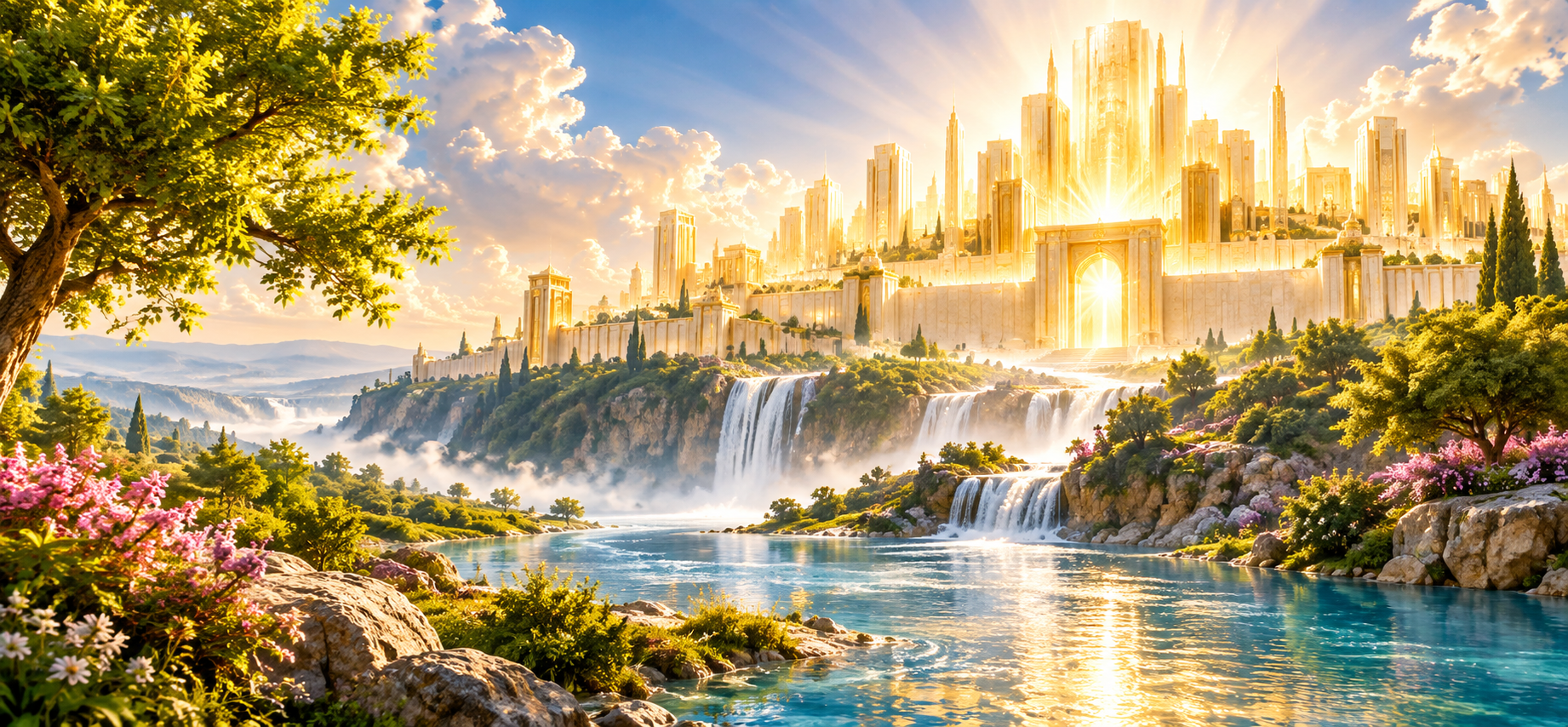
Featured Snippet: The new heaven and new earth described in Revelation 21–22 are the final stage of God’s plan for humanity. After the Millennium, the Great White Throne Judgment, and the destruction of death itself, God makes all things new. New Jerusalem comes down from heaven, God dwells with His family, and death, sorrow, crying, and pain are gone forever.
The Bible’s final chapters contain one of the most hopeful promises in all of Scripture.
After describing wars, persecution, the Great Tribulation, Christ’s return, the Millennium, the resurrection of the dead, and the final judgment, Revelation does not end with destruction.
It ends with a new beginning.
The apostle John sees a new heaven and a new earth. He sees New Jerusalem descending from heaven. He hears God declare that He will dwell with humanity. Death disappears. Sorrow and pain are gone. The tree of life appears again, and God’s servants live and reign with Him forever.
The story that began in Genesis with humanity separated from the tree of life ends in Revelation with humanity once again having access to it.
What exactly are the new heaven and new earth, and what do Revelation 21 and 22 reveal about God’s ultimate purpose for humanity?
What Happens Before the New Heaven and New Earth?
Revelation presents these events in a deliberate sequence.
Jesus Christ returns and establishes His rule over the earth. The saints are resurrected and reign with Him for 1,000 years (Revelation 20:4–6).
After the Millennium comes the resurrection associated with the Great White Throne Judgment. The dead stand before God, the books are opened, and the Book of Life is opened (Revelation 20:11–15).
Finally, death itself is destroyed.
Revelation 20:14 says:
“Then Death and Hades were cast into the lake of fire. This is the second death.”
Only after these events does John say:
“Now I saw a new heaven and a new earth, for the first heaven and the first earth had passed away” (Revelation 21:1).
The new heaven and new earth therefore belong to the final stage of God’s plan, after God’s work of judgment and salvation among mortal humanity has been completed.
What Are the New Heaven and New Earth?
John writes:
“Now I saw a new heaven and a new earth, for the first heaven and the first earth had passed away. Also there was no more sea” (Revelation 21:1).
The apostle Peter describes the same future transformation.
He writes that:
“the heavens will pass away with a great noise, and the elements will melt with fervent heat” (2 Peter 3:10).
Peter then says:
“Nevertheless we, according to His promise, look for new heavens and a new earth in which righteousness dwells” (verse 13).
The present creation is therefore not permanent.
The world we know—marked by corruption, suffering and death—will ultimately give way to a renewed creation in which righteousness permanently dwells.
God declares:
“Behold, I make all things new” (Revelation 21:5).
This is not merely the repair of human civilization.
It is the beginning of an entirely new order of existence.
What Is the New Jerusalem?
After seeing the new heaven and new earth, John sees something extraordinary:
“Then I, John, saw the holy city, New Jerusalem, coming down out of heaven from God” (Revelation 21:2).
Notice the direction.
Human beings are not pictured abandoning the earth and permanently going to heaven.
Instead, New Jerusalem comes down from heaven to the new earth.
Later John is shown the city in greater detail:
“Come, I will show you the bride, the Lamb’s wife” (Revelation 21:9).
John then sees:
“the great city, the holy Jerusalem, descending out of heaven from God” (verse 10).
The city is described in magnificent symbolic language—radiant with God’s glory, surrounded by great walls and gates, and built with precious stones and pure gold.
Its dimensions emphasize its enormous scale and perfection (Revelation 21:15–17).
But the most important feature of New Jerusalem is not its architecture.
It is who lives there.
God Will Dwell With Humanity
John hears a great voice from heaven proclaim:
“Behold, the tabernacle of God is with men, and He will dwell with them” (Revelation 21:3).
This statement brings the entire biblical story toward its conclusion.
Throughout Scripture, God desired to dwell among His people.
God’s presence was represented in the tabernacle in the wilderness and later in the temple at Jerusalem.
Jesus Christ came and “dwelt among us” (John 1:14).
God now dwells spiritually in converted Christians through His Spirit.
But Revelation 21 describes the ultimate fulfillment.
God Himself will dwell with His family.
Revelation continues:
“They shall be His people. God Himself will be with them and be their God” (Revelation 21:3).
The separation between God and humanity that began with sin will finally be gone.
There Will Be No More Death
One of Scripture’s most beautiful promises immediately follows:
“And God will wipe away every tear from their eyes; there shall be no more death, nor sorrow, nor crying” (Revelation 21:4).
Then John adds:
“There shall be no more pain, for the former things have passed away.”
Consider the magnitude of that promise.
No more death.
No more funerals.
No more grief.
No more disease.
No more suffering.
No more tears caused by separation and loss.
Death—the enemy that has followed humanity from the beginning—will no longer exist.
Until that final victory over death, Scripture describes the dead as awaiting a future resurrection, a subject explained more fully in What Happens After Death?
Paul wrote:
“The last enemy that will be destroyed is death” (1 Corinthians 15:26).
Revelation shows us the fulfillment of that promise.
“Behold, I Make All Things New”
God then makes one of the most sweeping declarations in Scripture:
“Behold, I make all things new” (Revelation 21:5).
God does not say merely that He makes some things new.
He makes all things new.
Human history has been filled with kingdoms rising and falling, wars, suffering, injustice and death.
But none of those things will have the final word.
God does.
The Bible’s prophetic story therefore does not ultimately point toward destruction.
It points toward restoration and renewal under God.
The judgments described throughout prophecy clear the way for a creation in which sin and death no longer dominate.
Why Is There No Temple in New Jerusalem?
John notices something surprising about the holy city:
“But I saw no temple in it” (Revelation 21:22).
Why would God’s city have no temple?
John immediately explains:
“For the Lord God Almighty and the Lamb are its temple.”
Throughout biblical history, a temple represented a place where human beings could approach God’s presence.
But in New Jerusalem, no separate temple is necessary.
God Himself is present.
There is no need for a physical building symbolizing access to God when God’s family dwells directly in His presence.
Why Are the Sun and Moon No Longer Needed for Light?
John continues:
“The city had no need of the sun or of the moon to shine in it, for the glory of God illuminated it” (Revelation 21:23).
He adds:
“The Lamb is its light.”
Revelation 22:5 similarly states:
“There shall be no night there: They need no lamp nor light of the sun, for the Lord God gives them light.”
The text does not necessarily say that the sun and moon cease to exist. Rather, New Jerusalem has no need for them as sources of illumination.
God’s glory provides its light.
This imagery emphasizes a profound truth: God’s presence completely fills the city.
There will never again be spiritual darkness.
What Are the River of Life and the Tree of Life?
Revelation 22 takes us inside New Jerusalem.
John sees:
“a pure river of water of life, clear as crystal, proceeding from the throne of God and of the Lamb” (Revelation 22:1).
Then he sees something that has not appeared prominently in Scripture since Genesis:
“In the middle of its street, and on either side of the river, was the tree of life” (verse 2).
The tree of life first appeared in the Garden of Eden.
After Adam and Eve sinned, God prevented them from taking from it and living forever in their sinful condition (Genesis 3:22–24).
Human beings were separated from the tree of life.
But at the end of Revelation, the tree appears again.
Revelation 22:14 declares:
“Blessed are those who do His commandments, that they may have the right to the tree of life.”
The Bible begins with humanity losing access to the tree of life.
It ends with God’s redeemed family having access to it again.
The circle is complete.
God’s Servants Will See His Face
Perhaps one of the most extraordinary promises in Revelation appears in chapter 22:
“They shall see His face, and His name shall be on their foreheads” (Revelation 22:4).
Throughout Scripture, sinful human beings could not simply stand in the fullness of God’s glory.
God told Moses:
“You cannot see My face; for no man shall see Me, and live” (Exodus 33:20).
Yet Revelation describes a future when God’s glorified children will see His face.
The relationship between God and His family will no longer be hindered by mortal weakness or sin.
They will dwell directly in His presence.
“They Shall Reign Forever and Ever”
Revelation 22:5 concludes:
“And they shall reign forever and ever.”
Earlier, Revelation describes the resurrected saints reigning with Christ for 1,000 years following the return of Jesus Christ (Revelation 20:4–6).
But God’s purpose does not end when the Millennium ends.
The destiny of God’s children extends into eternity.
Jesus Christ spoke of this inheritance when He said:
“Come, you blessed of My Father, inherit the kingdom prepared for you from the foundation of the world” (Matthew 25:34).
This eternal inheritance is the ultimate fulfillment of God’s Kingdom, the central message Jesus Christ proclaimed throughout His ministry.
God’s plan is ultimately about building a family that will share eternal life with Him.
The Millennium is an important stage in that plan.
The Great White Throne Judgment is another.
But Revelation 21–22 takes us beyond both—to the eternal future God has prepared.
Does Everyone Automatically Enter New Jerusalem?
Revelation’s message of hope does not eliminate human responsibility.
God offers eternal life, but human beings must respond to Him.
Revelation 21:7 says:
“He who overcomes shall inherit all things, and I will be his God and he shall be My son.”
By contrast, Revelation warns that those who persistently reject God’s way will not inherit His Kingdom (Revelation 21:8).
God does not force anyone to choose life.
The entire plan of salvation—from repentance and conversion to resurrection and eternal life—rests upon God’s grace while also calling human beings to faithfully respond to Him in obedience.
Eternal life is God’s gift.
But those who receive that gift willingly choose to live under His loving rule.
What Does the New Heaven and New Earth Reveal About God’s Purpose?
The Bible begins with God creating the heavens and the earth.
It ends with God creating a new heaven and a new earth.
Genesis begins with a garden, a river and the tree of life.
Revelation ends with a river and the tree of life.
Genesis records humanity’s separation from God because of sin.
Revelation ends with God’s children seeing His face.
The parallels are remarkable.
God’s purpose has always been greater than simply rescuing human beings from punishment.
He is creating a family.
Paul wrote:
“I will be a Father to you, and you shall be My sons and daughters, says the LORD Almighty” (2 Corinthians 6:18).
Revelation 21 expresses the same purpose:
“He who overcomes shall inherit all things, and I will be his God and he shall be My son” (verse 7).
From Genesis to Revelation, God’s plan moves toward this extraordinary conclusion.
The Final Message of Bible Prophecy
Bible prophecy contains serious warnings.
It describes human rebellion, deception, war, persecution, tribulation and divine judgment.
Those warnings matter.
But they are not the final message of prophecy.
Understanding why Bible prophecy matters helps us see that its purpose is not merely to predict frightening events, but to point us toward God’s plan, His Kingdom, and the hope He offers humanity.
The final chapters of Revelation do not leave God’s people staring at the Beast, Babylon, Armageddon or the Great Tribulation.
They direct our attention beyond those events.
Beyond the Tribulation is Christ’s return.
Beyond Christ’s return is His Kingdom.
Beyond the Millennium is the resurrection and Great White Throne Judgment.
And beyond judgment is a new heaven and a new earth where righteousness dwells.
That is where Bible prophecy ultimately leads.
Conclusion
Revelation 21–22 provides the magnificent conclusion to the biblical story.
The Great White Throne Judgment has been completed. Death has been destroyed. The former world has passed away.
Then God makes all things new.
New Jerusalem descends from heaven. God dwells with His family. There is no more death, sorrow, crying or pain. The river of life flows from God’s throne. The tree of life stands freely available. God’s servants see His face and reign forever.
The Bible begins with humanity separated from God and barred from the tree of life.
It ends with God’s children dwelling in His presence with access to the tree of life forever.
The final message of Bible prophecy is not destruction—it is the fulfillment of God’s purpose: “Behold, I make all things new.”