
Featured Snippet: The Great White Throne Judgment described in Revelation 20:11–15 is a future resurrection and time of judgment for people who lived and died without receiving a genuine opportunity to understand God’s truth. The Bible shows that they will be raised, taught God’s way, and judged according to their response. This occurs after Christ’s 1,000-year reign and is followed by the final judgment and the lake of fire.
The Great White Throne Judgment is one of the most remarkable—and often misunderstood—events described in Bible prophecy.
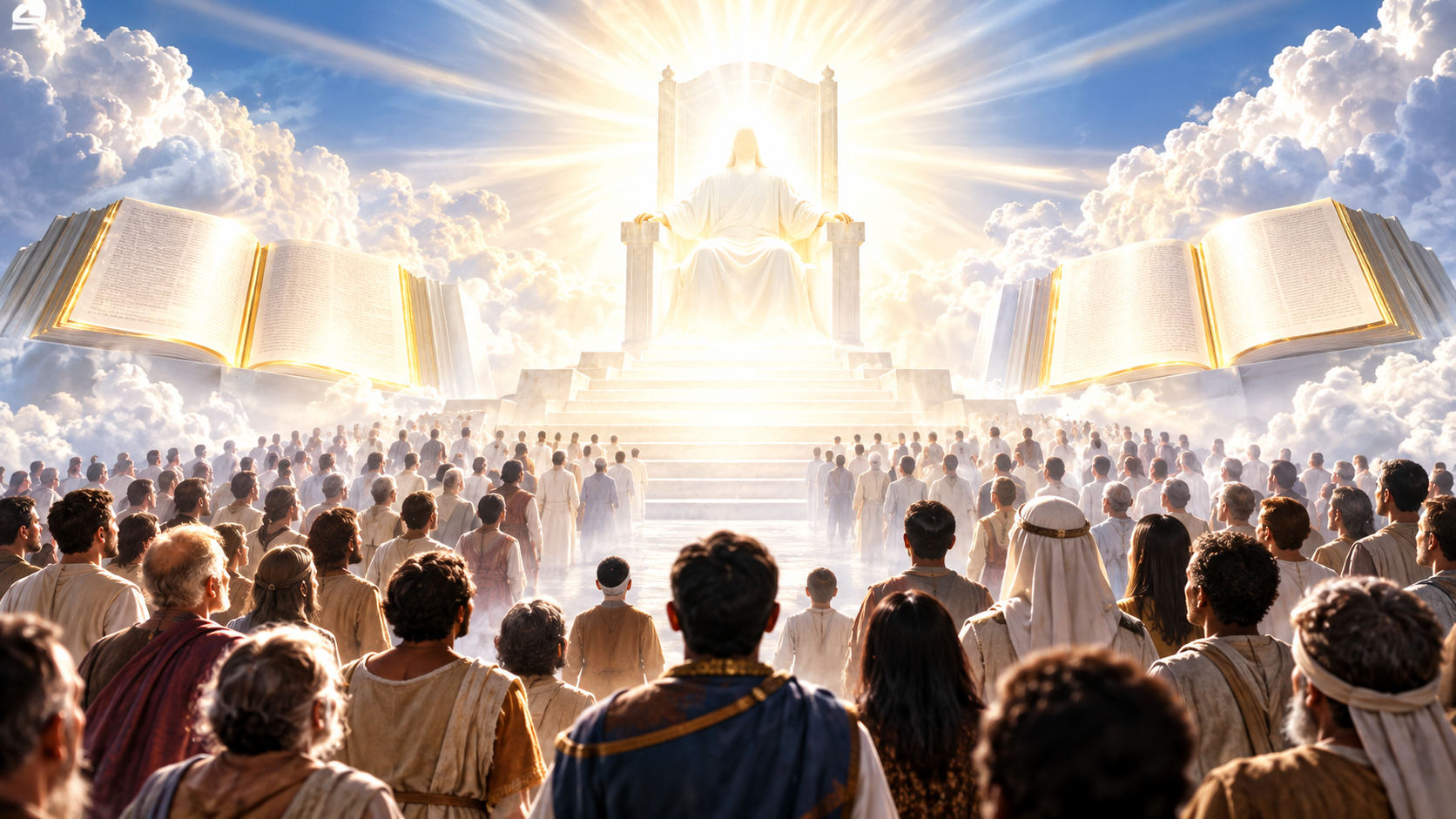
Revelation pictures the dead standing before a great white throne. Books are opened. The Book of Life is opened. And every person is judged according to his or her works.
For many readers, this sounds like a terrifying scene in which billions of people are resurrected only to hear their final sentence.
But is that what the Bible actually teaches?
When Revelation 20 is compared with other passages about resurrection and judgment, a much more complete picture emerges. The Great White Throne Judgment reveals something profound about God’s justice and mercy: God has not forgotten the countless people who lived and died without truly knowing Him.
Where Does the Bible Describe the Great White Throne Judgment?
The primary passage is Revelation 20:11–12:
“Then I saw a great white throne and Him who sat on it, from whose face the earth and the heaven fled away. And there was found no place for them. And I saw the dead, small and great, standing before God, and books were opened. And another book was opened, which is the Book of Life. And the dead were judged according to their works, by the things which were written in the books.”
The passage continues:
“The sea gave up the dead who were in it, and Death and Hades delivered up the dead who were in them. And they were judged, each one according to his works” (Revelation 20:13).
This is clearly a resurrection.
People who were dead are brought back to life and stand before God in judgment.
But notice something important: the Book of Life is opened.
That detail helps us understand the purpose of this resurrection.
When Does the Great White Throne Judgment Occur?
Revelation 20 gives us a sequence of events.
Jesus Christ returns to the earth. God’s faithful saints are resurrected in what Revelation calls “the first resurrection” (Revelation 20:4–6).
They reign with Christ for 1,000 years.
But Revelation specifically tells us:
“But the rest of the dead did not live again until the thousand years were finished” (Revelation 20:5).
Those words are crucial.
If there is a first resurrection, and “the rest of the dead” live again after the Millennium, then Scripture is describing another resurrection.
The Great White Throne Judgment occurs after Christ’s 1,000-year reign, when “the rest of the dead” are raised.
This is different from what happens to God’s faithful servants at Christ’s return. To understand that earlier resurrection, see what Happens at the Return of Christ?
Who Will Be Resurrected?
The Great White Throne Judgment includes people from throughout human history who never received a genuine opportunity to understand God’s truth and respond to His calling.
The Bible describes death as an unconscious state from which human beings await a future resurrection, as explained in What Happens After Death?
Jesus gave important clues about this resurrection.
Speaking to people who rejected Him, Christ said:
“The men of Nineveh will rise up in the judgment with this generation and condemn it” (Matthew 12:41).
He continued:
“The queen of the South will rise up in the judgment with this generation and condemn it” (verse 42).
Notice that Jesus spoke of people from completely different historical periods rising together in the judgment.
He made a similar statement concerning the ancient cities of Tyre, Sidon and Sodom:
“It will be more tolerable for the land of Sodom in the day of judgment than for you” (Matthew 11:24).
Christ therefore described ancient peoples being present in a future judgment.
They have not been forgotten.
They will rise again.
Does Everyone Receive an Opportunity for Salvation?
The Bible teaches that God desires people to be saved.
Paul wrote that God:
“desires all men to be saved and to come to the knowledge of the truth” (1 Timothy 2:4).
Peter similarly wrote that God is:
“not willing that any should perish but that all should come to repentance” (2 Peter 3:9).
Yet billions of human beings have lived and died without understanding the Bible, hearing the name of Jesus Christ, or receiving a genuine opportunity to respond to God’s calling.
What happens to them?
The Great White Throne Judgment helps answer that question.
God does not have to save everyone at the same moment in history.
Scripture shows an order to God’s plan of salvation.
Those whom God calls in this present age have an opportunity now. They are described as the firstfruits of God’s spiritual harvest (James 1:18; Revelation 14:4).
Others will receive their opportunity later.
This does not teach salvation without repentance or obedience. Rather, it demonstrates that God’s plan includes a genuine opportunity for people who previously did not understand His truth.
Ezekiel’s Vision of the Dry Bones
One of the clearest pictures of a future resurrection appears in Ezekiel 37.
The prophet Ezekiel was shown a valley filled with dry bones.
God asked him:
“Son of man, can these bones live?” (Ezekiel 37:3).
God then caused the bones to come together. Sinews and flesh appeared upon them. Breath entered them, and they lived.
God explained:
“These bones are the whole house of Israel” (verse 11).
These people knew they had died:
“Our bones are dry, our hope is lost, and we ourselves are cut off!”
God then promised:
“Behold, O My people, I will open your graves and cause you to come up from your graves” (verse 12).
This is not merely symbolic language about national restoration. The vision portrays people coming out of their graves and being restored to life.
And notice what God says will happen:
“Then you shall know that I am the LORD” (verse 13).
These resurrected people come to know God.
This fits remarkably well with the Great White Throne Judgment described in Revelation 20.
Will People Be Resurrected as Spirit Beings?
The resurrection pictured in Ezekiel 37 is clearly a resurrection to physical life.
This also helps clarify the Bible’s teaching about the nature of human beings. Rather than possessing an immortal soul that continues consciously after death, Scripture points to the resurrection as the hope of life after death, as explained in Is the Soul Immortal?
Bones come together.
Flesh covers them.
Breath enters them.
They live again as human beings.
This differs from the first resurrection at Christ’s return.
Paul explains that God’s faithful saints will then be changed from mortal to immortal:
“For this corruptible must put on incorruption, and this mortal must put on immortality” (1 Corinthians 15:53).
Those in the Great White Throne Judgment, however, are raised to physical life so they can learn God’s way, repent, receive His Spirit and develop godly character.
Their resurrection provides an opportunity for salvation—not automatic salvation.
What Does It Mean That “Books Were Opened”?
Revelation 20:12 says:
“And books were opened.”
The Greek word translated “books” is biblia, from which our English word Bible ultimately derives.
The opening of the books can therefore be understood as God’s truth being opened to the understanding of those who are resurrected.
During their previous lives, many never understood that truth.
Now they will have the opportunity to learn.
Isaiah describes a future time when:
“the earth shall be full of the knowledge of the LORD as the waters cover the sea” (Isaiah 11:9).
God’s truth will no longer be hidden beneath centuries of human confusion, competing religions and false teachings.
People will be able to know their Creator and understand His way of life.
Why Is the Book of Life Opened?
Revelation specifically distinguishes the books from another book:
“And another book was opened, which is the Book of Life” (Revelation 20:12).
Why would the Book of Life be opened if everyone standing before the throne had already been permanently condemned?
Its presence points to the possibility of life.
Those resurrected during this judgment will be responsible for what they learn and for how they respond to God.
They must repent.
They must believe.
They must choose God’s way.
Their names can be written in the Book of Life as they respond faithfully to God’s calling.
The Great White Throne Judgment therefore reveals both God’s mercy and human responsibility.
What Does “Judged According to Their Works” Mean?
Revelation repeatedly says that people will be judged according to their works.
This does not mean people earn salvation through good deeds.
Scripture clearly teaches:
“For by grace you have been saved through faith…it is the gift of God, not of works” (Ephesians 2:8–9).
But the next verse explains that Christians are:
“created in Christ Jesus for good works” (verse 10).
Works reveal how a person responds to God.
Judgment therefore involves more than simply pronouncing a sentence. Biblical judgment can involve a process of evaluation during which people are accountable for how they respond to God’s truth.
Peter even wrote:
“For the time has come for judgment to begin at the house of God” (1 Peter 4:17).
Christians are under judgment now.
In the same way, those raised in the Great White Throne Judgment will live under God’s judgment as they learn and respond to His way.
How Long Will the Great White Throne Judgment Last?
Revelation 20 does not directly state how long this period of judgment lasts.
Some connect this period with Isaiah 65:20, which speaks of a person dying at a hundred years old. This has led to the understanding that those resurrected may be given a substantial period of physical life in which to learn and practice God’s way.
However, Scripture does not explicitly state in Revelation 20 that the Great White Throne Judgment lasts exactly 100 years.
The central point is clearer than the precise duration: those resurrected will have a meaningful opportunity to know God and respond to Him.
Is the Great White Throne Judgment a Second Chance?
It is sometimes called a “second chance,” but that description can be misleading.
For many of those resurrected, this will be their first genuine opportunity to understand God’s truth.
Consider someone who lived thousands of years before Christ in a distant civilization and never heard God’s Word.
Or someone who lived and died knowing nothing about Jesus Christ.
God is perfectly just.
He does not condemn people because they never possessed knowledge they had no opportunity to receive.
Jesus said:
“No one can come to Me unless the Father who sent Me draws him” (John 6:44).
God determines when a person receives that calling.
The Great White Throne of Judgment demonstrates that God’s plan extends far beyond the relatively small number of people who understand His truth today.
What Happens to Those Who Ultimately Reject God?
God’s mercy does not eliminate human choice.
People who understand God’s truth and knowingly, permanently reject His way will not be forced to accept eternal life.
Revelation 20:14–15 states:
“Then Death and Hades were cast into the lake of fire. This is the second death. And anyone not found written in the Book of Life was cast into the lake of fire.”
Notice the expression “second death.”
This is death—not eternal conscious life in torment.
This distinction is important when considering the Bible’s teaching about the final punishment of the wicked, which we examine more fully in Is Hell Eternal Torment?
Those who ultimately reject God perish. They are not tortured for eternity.
Jesus expressed the same principle:
“For God so loved the world that He gave His only begotten Son, that whoever believes in Him should not perish but have everlasting life” (John 3:16).
The alternatives are eternal life or perishing.
The lake of fire represents the final destruction of those who knowingly refuse God’s gift of life.
What Happens After the Great White Throne Judgment?
These events are part of the larger biblical story of the Kingdom of God and God’s purpose for humanity.
After judgment is completed and death itself has been destroyed, Revelation describes something extraordinary:
“Now I saw a new heaven and a new earth” (Revelation 21:1).
Then God declares:
“Behold, the tabernacle of God is with men, and He will dwell with them” (verse 3).
There will be no more death, sorrow, crying or pain.
God says:
“Behold, I make all things new” (verse 5).
The Great White Throne Judgment therefore stands near the completion of God’s plan for humanity.
From the first human beings in Genesis to the final resurrection in Revelation, God’s purpose is ultimately about bringing human beings into His family and giving eternal life to those who willingly choose His way.
“For you are all sons of God through faith in Christ Jesus.” (Galatians 6:26)
What Does the Great White Throne Judgment Reveal About God?
This prophecy reveals a God who is both just and merciful.
No human being will be forgotten simply because he or she lived in the wrong century, the wrong country or under circumstances where God’s truth was never understood.
God knows every person who has ever lived.
Jesus said:
“The hour is coming in which all who are in the graves will hear His voice and come forth” (John 5:28–29).
For countless human beings, their story does not end in the grave.
They will live again.
They will know their Creator.
They will learn His truth.
And they will have the opportunity to choose life.
Conclusion
The Great White Throne Judgment is not merely a frightening courtroom scene at the end of the Bible.
It is an essential part of God’s plan of salvation.
After Jesus Christ returns and reigns for 1,000 years, the rest of the dead will be raised. People from generations throughout human history will stand before God. The books will be opened. The Book of Life will be opened. And those who never truly knew God will have the opportunity to learn His truth and respond to Him.
God’s plan is far greater than many realize.
The billions who lived and died without understanding God’s truth have not been forgotten.
The Great White Throne Judgment reveals that with God, death is not the end—and no one will be denied the opportunity God intends for them to have.