
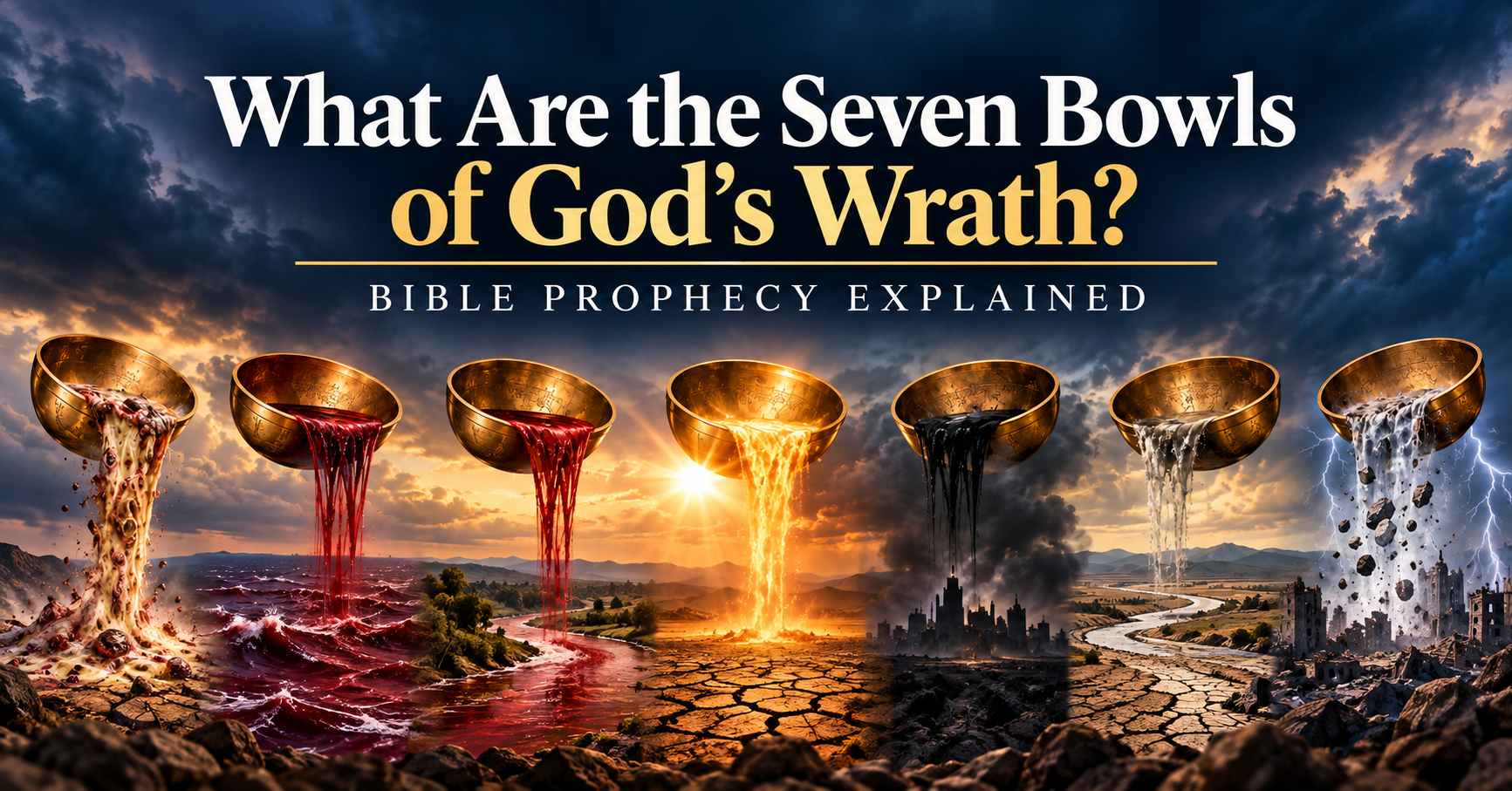
The book of Revelation describes a series of dramatic events that culminate in the return of Jesus Christ. Among the final judgments described are the seven bowls of God’s wrath, sometimes called the seven last plagues.
Revelation 15 introduces seven angels carrying these final plagues:
“Then I saw another sign in heaven, great and marvelous: seven angels having the seven last plagues, for in them the wrath of God is complete” (Revelation 15:1).
These judgments are described in Revelation 15 and 16. They come near the climax of end-time events and lead directly toward the gathering of the nations at Armageddon and the return of Jesus Christ.
Understanding the seven bowls helps us see how the final events of Revelation fit together—and why Christ repeatedly warns His followers to remain spiritually awake.
Featured Snippet
What are the seven bowls of God’s wrath? The seven bowls are seven final plagues described in Revelation 15–16. They include painful sores, the seas and fresh waters becoming blood, scorching heat, darkness, the drying of the Euphrates River, and a devastating earthquake and hail. They culminate as the nations gather for battle before the return of Jesus Christ.
Why Are They Called the Seven Bowls of God’s Wrath?
Revelation describes seven angels receiving “seven golden bowls full of the wrath of God” (Revelation 15:7).
Then a voice from the temple commands:
“Go and pour out the bowls of the wrath of God on the earth” (Revelation 16:1).
The Greek word translated bowl refers to a broad, shallow vessel. The imagery portrays God’s judgment being poured out upon a rebellious world.
These are not random disasters. Revelation presents them as divine judgments occurring during the climactic period immediately preceding Christ’s intervention in world affairs.
Revelation 15:1 calls them the “seven last plagues” because through them “the wrath of God is complete.”
To understand where they fit, we need to look briefly at the larger prophetic sequence.
Where Do the Seven Bowls Fit in Revelation?
Revelation presents several major sequences of end-time events.
The seven seals begin the prophetic sequence described in Revelation 6. The seventh seal introduces seven trumpet judgments (Revelation 8:1-2).
The seventh trumpet announces the approaching reign of Jesus Christ:
“The kingdoms of this world have become the kingdoms of our Lord and of His Christ, and He shall reign forever and ever!” (Revelation 11:15).
The seven bowls are associated with this final stage of God’s judgment.
They are called the seven last plagues, indicating that they bring the period of divine wrath toward its conclusion.
The progression can be summarized:
Seven Seals → Seven Trumpets → Seven Bowls → Return of Jesus Christ
The bowls therefore belong to the final phase of the Day of the Lord and lead directly toward the confrontation associated with Armageddon.
The First Bowl: Painful Sores
The first angel pours out his bowl upon the earth:
“And a foul and loathsome sore came upon the men who had the mark of the beast and those who worshiped his image” (Revelation 16:2).
This judgment specifically affects those who have accepted the mark of the beast and participated in the worship of the beast.
Earlier, Revelation warned against doing this:
“If anyone worships the beast and his image, and receives his mark on his forehead or on his hand, he himself shall also drink of the wine of the wrath of God” (Revelation 14:9-10).
The first bowl demonstrates that allegiance to the beast system ultimately brings devastating consequences.
The Second Bowl: The Sea Becomes Blood
The second angel pours his bowl upon the sea:
“And it became blood as of a dead man; and every living creature in the sea died” (Revelation 16:3).
Earlier trumpet judgments affected portions of the sea, but this plague is described on a much greater scale.
The consequences would be catastrophic.
The oceans are essential to life on earth. They provide food, transportation, commerce and ecological stability. Revelation portrays a devastating judgment affecting marine life throughout the sea.
The Third Bowl: Rivers and Springs Become Blood
The third bowl affects fresh water:
“Then the third angel poured out his bowl on the rivers and springs of water, and they became blood” (Revelation 16:4).
An angel then declares that God’s judgment is righteous because those being judged had shed the blood of God’s servants:
“For they have shed the blood of saints and prophets, and You have given them blood to drink. For it is their just due” (verses 5-6).
The passage emphasizes an important theme running throughout Revelation: God’s judgments are not arbitrary.
Human rebellion, violence and persecution have consequences.
The bowls demonstrate God’s response to a world that continually refuses His authority.
The Fourth Bowl: Scorching Heat From the Sun
The fourth angel pours his bowl upon the sun:
“And power was given to him to scorch men with fire” (Revelation 16:8).
Human beings are scorched with intense heat.
Yet something remarkable happens.
Rather than repenting, people respond by blaspheming God:
“And they did not repent and give Him glory” (verse 9).
This reveals one of the sobering lessons of Revelation.
Suffering alone does not necessarily produce repentance.
Even when confronted with unmistakable divine judgment, hardened human beings may continue resisting God.
True repentance requires a change of heart—a willingness to acknowledge sin and turn toward God.
The Fifth Bowl: Darkness on the Beast’s Kingdom
The fifth bowl is poured directly upon the political power identified as the beast:
“Then the fifth angel poured out his bowl on the throne of the beast, and his kingdom became full of darkness” (Revelation 16:10).
The people suffer intensely:
“They gnawed their tongues because of the pain.”
Yet again Revelation tells us:
“They blasphemed the God of heaven because of their pains and their sores, and did not repent of their deeds” (verse 11).
The kingdom that appeared powerful and dominant is plunged into darkness and suffering.
Human political and military power cannot stand against the judgment of Almighty God.
The Sixth Bowl: The Euphrates Is Dried Up
The sixth bowl moves the prophecy toward one of Revelation’s most famous events—Armageddon.
“Then the sixth angel poured out his bowl on the great river Euphrates, and its water was dried up, so that the way of the kings from the east might be prepared” (Revelation 16:12).
The Euphrates River has historically served as a major geographic barrier separating regions east and west of the Middle East.
Revelation describes the river being dried up so that armies can move toward the final conflict.
But military movement is only part of the story.
John sees demonic spirits performing signs:
“And I saw three unclean spirits like frogs coming out of the mouth of the dragon, out of the mouth of the beast, and out of the mouth of the false prophet. For they are spirits of demons, performing signs, which go out to the kings [a]of the earth and of the whole world, to gather them to the battle of that great day of God Almighty.” (Revelation 16:13 -14)
The nations are being drawn toward a confrontation with God.
Armageddon and the Seven Bowls
Revelation then identifies the gathering place:
“And they gathered them together to the place called in Hebrew, Armageddon” (Revelation 16:16).
Armageddon is therefore directly connected with the sixth bowl.
It is important to notice what the passage actually says.
Armageddon is the place where the armies gather. Revelation later describes the actual confrontation with the returning Jesus Christ.
Revelation 19 portrays Christ returning as King of kings and Lord of lords, while the beast and the kings of the earth gather their armies against Him (Revelation 19:11-21).
What begins as conflict among human powers ultimately becomes resistance against the returning Christ.
Human government reaches the ultimate expression of rebellion against its Creator.
And right in the middle of the description of the sixth bowl, Jesus gives a warning to His followers.
Christ’s Warning: “Blessed Is He Who Watches”
Between the description of the gathering armies and Armageddon itself, Revelation records Christ saying:
“Behold, I am coming as a thief. Blessed is he who watches, and keeps his garments” (Revelation 16:15).
This verse interrupts the description of armies, demons and warfare with a deeply personal warning.
Christ tells His followers to watch.
The primary lesson of Bible prophecy is not merely to identify nations, military movements or prophetic events.
It is to remain spiritually prepared.
Jesus gave the same warning in the Olivet Prophecy:
“Watch therefore, for you do not know what hour your Lord is coming” (Matthew 24:42).
Prophecy should motivate Christians toward repentance, faithfulness, obedience and spiritual vigilance.
The Seventh Bowl: “It Is Done!”
The seventh angel pours his bowl into the air:
“And a loud voice came out of the temple of heaven, from the throne, saying, ‘It is done!’” (Revelation 16:17).
The final bowl brings enormous upheaval.
Revelation describes:
- Voices, thunder and lightning.
- The greatest earthquake in human history.
- Cities of the nations falling.
- Islands disappearing.
- Mountains no longer being found.
- Enormous hailstones falling upon mankind.
The earthquake is described in extraordinary terms:
“Such a mighty and great earthquake as had not occurred since men were on the earth” (verse 18).
The world’s political, geographic and social order is being shaken to its foundations.
Yet even at this point, Revelation says people continue to blaspheme God rather than repent (verse 21).
Human rebellion has reached its climax.
Are the Seven Bowls Literal or Symbolic?
Revelation contains extensive symbolism, so readers naturally ask whether the seven bowls should be understood literally.
Some details clearly carry symbolic significance. For example, the bowls themselves symbolize God’s wrath being poured out.
However, the judgments they describe produce real consequences upon the earth.
The safest approach is to allow Scripture to interpret Scripture rather than forcing every detail into either an entirely literal or entirely symbolic framework.
Revelation presents these plagues as real acts of divine judgment, even when symbolic imagery is used to describe them.
Their central meaning is unmistakable: human civilization has reached a point where God directly intervenes.
Why Would a Loving God Pour Out Wrath?
The severity of these judgments can be difficult to read.
But Scripture does not portray God as delighting in human suffering.
God told ancient Israel:
“I have no pleasure in the death of the wicked, but that the wicked turn from his way and live” (Ezekiel 33:11).
God desires repentance.
But He also allows humanity to choose whether to obey Him or reject Him.
For thousands of years, human beings have pursued their own systems of government, warfare, religion and morality apart from God’s rule. Scripture shows where that path ultimately leads.
Jesus warned that the final crisis would become so severe that humanity would face destruction if God did not intervene:
“And unless those days were shortened, no flesh would be saved” (Matthew 24:22).
God’s intervention ultimately prevents humanity from destroying itself.
The seven bowls are therefore not the end of God’s purpose for humanity.
They immediately precede a dramatic change in world government.
The Seven Bowls Lead to the Kingdom of God
The message of Revelation does not end with plagues and destruction.
It ends with Jesus Christ ruling the nations.
Revelation 19 describes the return of Jesus Christ in power and glory.
The governments and armies resisting Him will not prevail.
Human rule apart from God will give way to the government of God.
This is the same Kingdom Jesus preached throughout His ministry.
The gospel—the good news—is ultimately about the coming Kingdom of God.
The seven bowls mark the final collapse of human resistance before that Kingdom is established over the earth.
What Should Christians Learn From the Seven Bowls?
The seven bowls are not given merely to satisfy curiosity about future disasters.
They contain important spiritual lessons.
First, God takes sin seriously. Humanity cannot continually reject God’s authority without consequences.
Second, political and military power cannot save humanity. Even the most powerful governments collapse when confronted by God’s intervention.
Third, repentance matters. Revelation repeatedly notes that people refuse to repent even while experiencing judgment.
Fourth, Christians must remain spiritually alert. Jesus places His warning to “watch” directly within the account of the sixth bowl.
And finally, God’s Kingdom will prevail.
The frightening events of Revelation are temporary.
The government established by Jesus Christ will not be.
A Warning—and a Message of Hope
The seven bowls of God’s wrath represent some of the most severe judgments described anywhere in Scripture.
But they are not the final message of Revelation.
The final message is hope.
Jesus Christ returns.
Human warfare ends.
The rule of the beast is destroyed.
God’s Kingdom is established.
And Christ begins restoring the earth under righteous government.
That is why Christians should study prophecy without becoming consumed by fear or speculation.
Jesus told His disciples:
“Now when these things begin to happen, look up and lift up your heads, because your redemption draws near” (Luke 21:28).
The purpose of prophecy is not simply to know what happens next.
It is to help us recognize where human rebellion ultimately leads—and to prepare ourselves spiritually for the return of Jesus Christ.
The seven bowls bring mankind’s rebellion to its final crisis.
But beyond that crisis stands the hope at the heart of the gospel:
Jesus Christ will return, the Kingdom of God will be established, and God’s righteous government will ultimately bring peace to the earth.
Continue Studying:
To understand how the seven bowls fit into the larger sequence of Bible prophecy, continue with these studies: