
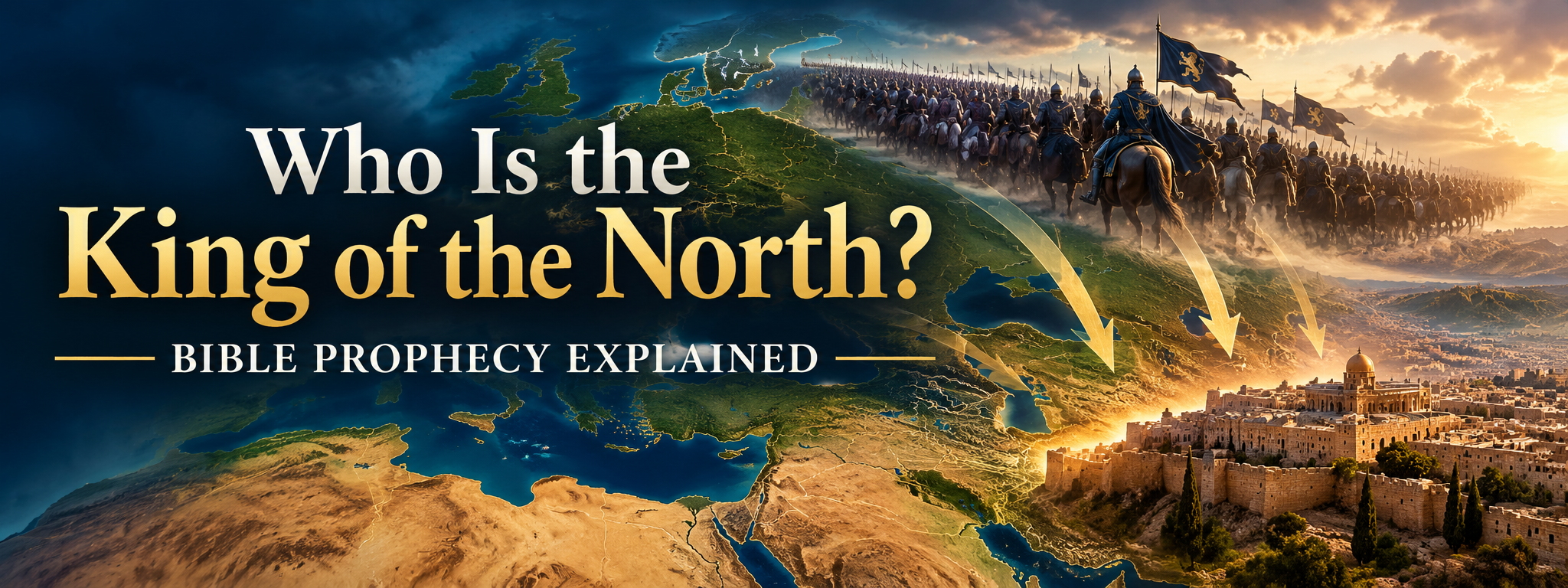
Daniel 11 contains one of the Bible’s most detailed prophecies. It describes centuries of conflict between two powers called the King of the North and the King of the South.
Much of this prophecy was fulfilled through ancient kingdoms that fought for control of the Middle East. But Daniel’s prophecy does not stop in ancient history. It eventually moves forward to “the time of the end” (Daniel 11:40).
At that time, Scripture describes a powerful King of the North sweeping into the Middle East, entering the Holy Land and becoming involved in events leading toward the return of Jesus Christ.
Who is this King of the North? And what does his appearance tell us about end-time Bible prophecy?
Featured Snippet
Who is the King of the North in Bible prophecy? Daniel 11 uses the title King of the North for rulers whose power was centered north of Jerusalem. Historically, this included the Seleucid dynasty. In the end-time fulfillment, the prophecy points to a powerful European-centered ruler who will invade the Middle East and whose actions ultimately lead into events surrounding the return of Jesus Christ.
Where Does the King of the North Appear in the Bible?
The expression appears primarily in Daniel 11.
Daniel received this prophecy during the Persian Empire. The vision foretold political and military events that would unfold long after Daniel’s lifetime.
The prophecy begins with Persia, moves to the rise of Greece and then describes the fragmentation of Alexander the Great’s empire.
Daniel 11:4 foretold that Alexander’s kingdom would be:
“Broken up and divided toward the four winds of heaven.”
After Alexander’s death in 323 B.C., his empire eventually became divided among four major successors.
Two of these kingdoms became particularly important to biblical prophecy.
One was centered in Egypt, south of Jerusalem.
The other was centered in Syria and surrounding territories, north of Jerusalem.
They became known prophetically as the King of the South and the King of the North.
The bible identifies the ancient lines primarily with the Ptolemaic rulers of Egypt and the Seleucid rulers of Syria, named from their locations relative to Jerusalem.
Why “North” and “South”?
The terms north and south are best understood from the perspective of the Holy Land.
Jerusalem stands near the geographic center of Daniel 11’s story.
The King of the South ruled territory centered primarily in Egypt.
The King of the North ruled territory centered primarily in Syria and the regions beyond it.
For generations these competing dynasties struggled for dominance, with Judea caught between them.
This geographic perspective becomes important later because the prophecy again focuses on Jerusalem as end-time events unfold.
Antiochus IV Epiphanes and the King of the North
One of the most notorious ancient rulers in Daniel 11 was Antiochus IV Epiphanes, a Seleucid king who ruled during the second century B.C.
Daniel foretold actions associated with his reign, including persecution and the desecration of the sanctuary.
Daniel 11:31 says:
“And forces shall be mustered by him, and they shall defile the sanctuary fortress; then they shall take away the daily sacrifices, and place there the abomination of desolation.”
In 167 B.C., Antiochus suppressed Jewish worship and desecrated the temple at Jerusalem.
These events provide an important historical fulfillment of Daniel’s prophecy.
But they do not exhaust its meaning.
Jesus Christ later referred to the “abomination of desolation” spoken of by Daniel the prophet as something His disciples should watch for in connection with future events (Matthew 24:15).
Antiochus therefore provides an important historical pattern for understanding a later fulfillment.
Daniel’s Prophecy Reaches the Time of the End
Daniel 11 eventually makes an important transition.
Verse 40 begins:
“At the time of the end shall be the king of the south push at him: and the king of the north shall come against him like a whirlwind.”
Whatever happened in ancient history, this portion of the prophecy explicitly places the conflict at “the time of the end.”
The King of the North responds to an action by the King of the South with overwhelming military force.
Daniel describes him coming:
“With chariots, horsemen, and with many ships.”
The language describes a rapid and powerful military campaign.
He enters various countries, overwhelms them and continues southward.
The King of the North Enters the Holy Land
Daniel 11:41 continues:
“He shall also enter the Glorious Land.”
The Glorious Land refers to the land of Israel.
This places Jerusalem and the Middle East directly at the center of the prophecy.
The King of the North does not remain confined to Europe or the northern Mediterranean world. His military campaign carries him into the Middle East.
Daniel then says:
“He shall stretch out his hand against the countries, and the land of Egypt shall not escape” (verse 42).
The prophecy therefore describes a major geopolitical upheaval involving the Middle East shortly before Christ’s return.
Who Is the End-Time King of the North?
The bible identifies the end-time King of the North as the ruler of a European-centered political and military power that will arise shortly before Jesus Christ returns.
This interpretation follows the historical progression described in Daniel 11: the northern power passes from the Seleucid realm to Rome and ultimately to an end-time continuation of the Roman political system. The parallels between Daniel and Revelation point to the end-time King of the North as the ruler associated with the Beast power described in Revelation.
This does not mean that today’s European Union, a particular European nation or any present political leader should automatically be identified as the fulfillment.
Bible prophecy describes the final configuration that will exist at the time these events occur.
We should therefore be careful about trying to attach prophetic titles prematurely to contemporary individuals.
Is the King of the North the Beast of Revelation?
There are strong parallels between Daniel’s end-time ruler and the political leader called the Beast in Revelation.
Daniel describes a powerful ruler who exalts himself, wages war and exercises extraordinary authority.
Revelation 13 likewise describes a political power receiving great authority:
“And the dragon gave him his power, his throne, and great authority” (Revelation 13:2).
Revelation later describes ten kings who temporarily surrender their authority to the Beast:
“These are of one mind, and they will give their power and authority to the beast” (Revelation 17:13).
The bible identifies the end-time King of the North with this Beast ruler—a leader presiding over a final European-centered political power.
Daniel and Revelation therefore appear to describe the same final political system from different prophetic perspectives.
What Happens Between the King of the North and King of the South?
Daniel 11:40 describes a confrontation:
“At the time of the end shall be the king of the south push at him.”
The exact nature of this “push” is not explained.
Whatever provokes the confrontation, the King of the North responds overwhelmingly:
“And the king of the north shall come against him like a whirlwind.”
His forces sweep into the Middle East.
Egypt is specifically mentioned among the territories affected (Daniel 11:42-43).
Bible scholars have long interpreted the end-time King of the South as a Middle Eastern power or alignment arising south of the Holy Land, while acknowledging uncertainty about its precise future political composition.
The important point is not to guess which present-day leader will fill the role.
The prophecy tells us that major regional powers will emerge and clash during the time of the end.
Trouble Comes From the East and North
After the King of the North’s successful campaign, something changes.
Daniel 11:44 says:
“But news from the east and the north shall trouble him; therefore he shall go out with great fury to destroy and annihilate many.”
Other military powers apparently threaten his position.
He responds with tremendous violence.
The prophecy portrays a world rapidly descending into enormous international conflict.
These events fit the broader biblical picture of escalating warfare immediately before God’s intervention.
The King of the North Comes to Jerusalem
Daniel 11:45 gives another important geographic detail:
“And he shall plant the tents of his palace between the seas and the glorious holy mountain.”
The glorious holy mountain points toward Jerusalem.
The ruler therefore establishes his presence in the region surrounding the Holy Land.
Jerusalem becomes a focal point of the final crisis—just as Jesus warned in the Olivet Prophecy.
Yet Daniel adds:
“Yet he shall come to his end, and no one will help him.”
The King of the North may temporarily appear unstoppable.
But his power does not last.
Daniel 12 Shows When These Events Occur
The chapter division between Daniel 11 and Daniel 12 can sometimes obscure the flow of the prophecy.
Daniel 12 continues:
“At that time Michael shall stand up, the great prince who stands watch over the sons of your people; and there shall be a time of trouble, such as never was since there was a nation” (Daniel 12:1).
Jesus used very similar language when describing the Great Tribulation:
“For then there will be great tribulation, such as has not been since the beginning of the world until this time” (Matthew 24:21).
Daniel then describes resurrection:
“And many of those who sleep in the dust of the earth shall awake” (Daniel 12:2).
This places the final events of Daniel 11 in the prophetic setting surrounding the end of the age and Christ’s return.
These events ultimately lead toward the final military confrontation associated with Armageddon.
The King of the North Will Not Establish God’s Kingdom
The King of the North represents one of humanity’s final attempts to establish security and political order apart from God.
For a short time, this system will possess extraordinary military, political and economic power.
But Daniel says plainly:
“He shall come to his end.”
Revelation gives additional details about that end.
When Jesus Christ returns, the Beast and the kings allied with him gather against Christ:
“And I saw the beast, the kings of the earth, and their armies, gathered together to make war against Him who sat on the horse and against His army” (Revelation 19:19).
Their resistance fails.
The Beast’s political system is destroyed, and Jesus Christ assumes rulership over the nations.
Why Should Christians Study the King of the North?
Bible prophecy was not given merely so Christians could predict geopolitical headlines.
Jesus repeatedly emphasized spiritual readiness.
After describing end-time events, He said:
“Watch therefore, for you do not know what hour your Lord is coming” (Matthew 24:42).
Understanding the King of the North helps us recognize the broad prophetic framework Scripture gives for the end of the age.
But Christians should resist the temptation to identify every European leader, Middle Eastern conflict or international crisis as the immediate fulfillment of Daniel 11.
Prophecy should produce watchfulness—not speculation.
It should encourage repentance, faithfulness and confidence in God’s ultimate purpose.
The King of the North and the Coming Kingdom of God
Daniel’s prophecy ultimately points beyond the King of the North.
Human rulers rise.
Empires become powerful.
Nations fight for territory and influence.
And eventually they fall.
But God’s Kingdom does not.
Daniel had already been shown:
“The God of heaven will set up a kingdom which shall never be destroyed” (Daniel 2:44).
The King of the North may become one of the most powerful rulers of the final age, but his authority will be temporary.
Jesus Christ’s authority will not.
The real hope of Bible prophecy is therefore not found in determining which modern politician might become the King of the North.
It is found in knowing who ultimately replaces all human kingdoms.
Jesus Christ will return as King of kings and Lord of lords.
The governments of this world will give way to the Kingdom of God.
And unlike the kingdoms described throughout Daniel, His Kingdom will never come to an end.