
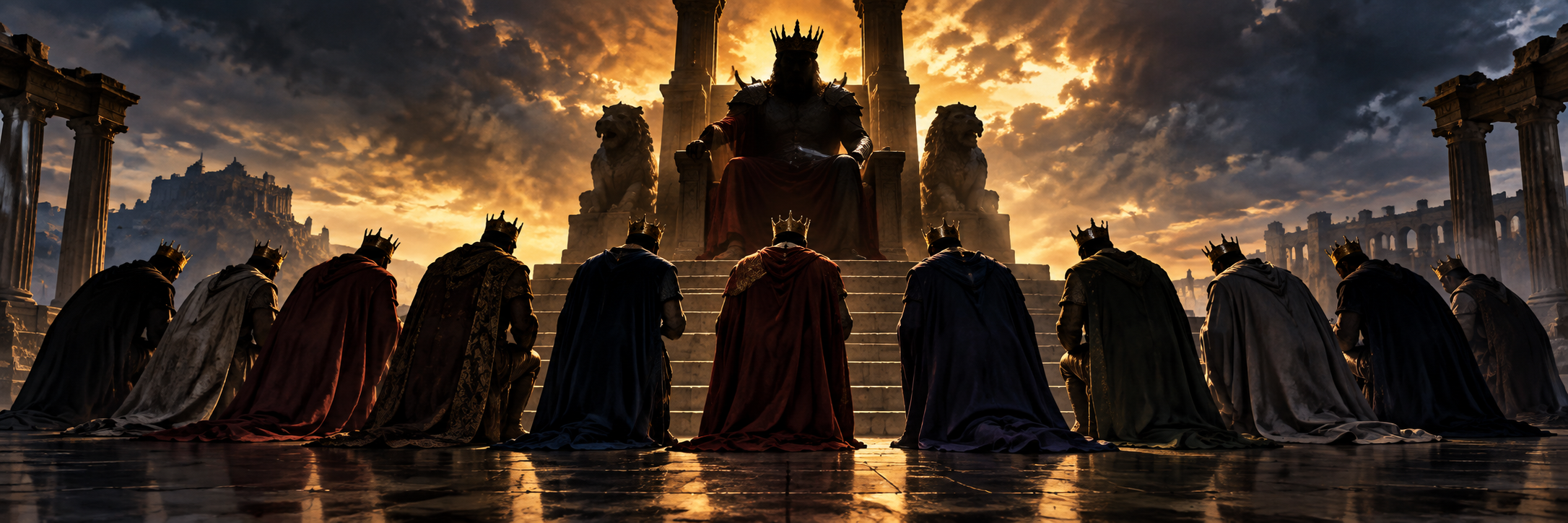
Featured Snippet: The ten kings of Revelation are ten end-time rulers who will receive authority with the Beast for a short period before the return of Jesus Christ. Revelation 17 says these rulers will voluntarily give their power and authority to the Beast and will ultimately make war against Christ. Their identity connects with the ten horns of Daniel 7 and the ten toes of the image in Daniel 2, pointing to a final alliance of rulers that will exist at the end of the age.
The book of Revelation describes a dramatic political alliance that will arise shortly before Jesus Christ returns.
The apostle John saw a Beast with ten horns, and an angel explained that those horns represented ten kings. These rulers will join together, surrender their authority to the Beast, and participate in the final rebellion against Jesus Christ.
Who are these ten kings? Are they ten specific nations? Have they already appeared? And how do they fit into the larger picture of Bible prophecy?
To understand them, we need to compare Revelation with the prophecies of Daniel.
Revelation Says the Ten Horns Are Ten Kings
The clearest explanation appears in Revelation 17:12-13:
“The ten horns which you saw are ten kings who have received no kingdom as yet, but they receive authority for one hour as kings with the beast. These are of one mind, and they will give their power and authority to the beast.”
Several important details emerge from this passage.
The ten horns represent ten kings. They receive authority during the same general period as the Beast. Their authority lasts only a relatively short time, and they willingly give their power and authority to the Beast.
This describes more than ten unrelated governments existing at the same time. Revelation portrays rulers who become united behind a dominant political and military power.
Their alliance plays an important role in the final events preceding Christ’s return.
Who Is the Beast They Support?
Revelation repeatedly describes a powerful end-time political system symbolized by a Beast.
Revelation 13 describes this power as exercising enormous political authority:
“And authority was given him over every tribe, tongue, and nation” (Revelation 13:7).
Revelation 17 adds another important detail. The ten kings will give their power and authority to the beast.
This means the ten kings retain enough governmental authority to surrender or transfer significant power to a larger political system.
The Beast therefore appears as the dominant leader or governing power of a broader alliance.
This also helps explain why the ten kings cannot be understood in isolation. Their identity is connected directly with the prophetic Beast system described throughout Revelation.
Revelation also identifies this Beast power with the mysterious number 666, another important clue to understanding the system described in prophecy.
The Ten Kings and the Ten Horns of Daniel 7
Revelation builds upon symbolism first introduced centuries earlier in the book of Daniel.
Daniel saw four great beasts representing successive kingdoms or empires.
The fourth beast was especially terrifying:
“It was different from all the beasts that were before it, and it had ten horns” (Daniel 7:7).
Daniel later received the interpretation:
“The ten horns are ten kings who shall arise from this kingdom” (Daniel 7:24).
Notice the similarity.
Daniel 7: ten horns represent ten kings.
Revelation 17: ten horns represent ten kings.
This parallel is significant. Revelation expands upon the prophetic framework established in Daniel.
Daniel’s fourth beast represents the Roman imperial system and its continuing historical legacy. The ten horns point ultimately toward rulers associated with the final manifestation of that system before God’s Kingdom replaces human government.
The Ten Toes of Daniel 2
Another important connection appears in Daniel 2.
King Nebuchadnezzar dreamed of a great image composed of several different materials. Daniel explained that these represented successive kingdoms.
The image had:
- a head of gold,
- chest and arms of silver,
- belly and thighs of bronze,
- legs of iron,
- and feet partly of iron and partly of clay.
The final portion of the image consisted of feet and toes composed of iron mixed with clay.
Daniel explained:
“Whereas you saw the feet and toes, partly of potter’s clay and partly of iron, the kingdom shall be divided” (Daniel 2:41).
This final political arrangement possesses strength but lacks complete unity.
Daniel continues:
“They will mingle with the seed of men; but they will not adhere to one another, just as iron does not mix with clay” (verse 43).
Although Daniel 2 does not explicitly say, “the ten toes are ten kings,” the ten toes occur in the same final stage of human government represented elsewhere by the ten horns.
Daniel 2, Daniel 7, and Revelation 17 therefore provide complementary pictures of the political system existing immediately before Christ establishes the Kingdom of God.
A Final Alliance of Rulers
Taken together, these prophecies point toward a final alliance of rulers.
They will maintain individual identities or governmental authority while becoming united under the Beast.
Revelation emphasizes their remarkable agreement:
“These are of one mind, and they will give their power and authority to the beast” (Revelation 17:13).
This cooperation may be extraordinary precisely because Daniel describes the final system as partly strong and partly fragile.
The nations or political entities involved do not naturally form a perfectly unified government. Yet circumstances will lead their rulers to cooperate and transfer considerable authority to a central power.
This alliance will become one of the dominant geopolitical forces of the final period of this age.
Are the Ten Kings Ten European Nations?
Because Daniel’s fourth beast is historically connected with the Roman Empire, the final ten-king alliance has traditionally been understood as arising from the geographic and political legacy of that system, centered in Europe.
This does not mean that every modern European political development fulfills Revelation 17.
Nor does Scripture give us permission to identify ten present-day countries and declare with certainty that they are the ten kings.
Political borders change. Nations reorganize. Alliances expand and contract.
The prophecy focuses primarily on ten rulers who possess authority at the time the final Beast power emerges.
The exact political structure may not become unmistakably clear until events themselves develop.
For that reason, Christians should be cautious about attaching prophecy too quickly to today’s political organizations or membership lists.
Are the Ten Kings Already in Power?
Revelation contains an important clue.
John was told:
“The ten horns which you saw are ten kings who have received no kingdom as yet” (Revelation 17:12).
In the prophetic setting John was shown, these rulers had not yet received their final authority.
They receive it “for one hour as kings with the beast.”
The expression emphasizes the brief duration of their authority in comparison with the broader sweep of history.
This suggests that the final alliance develops relatively close to the culmination of end-time events.
We should therefore be careful about declaring that particular contemporary leaders are the ten kings.
Scripture tells us what these rulers will do far more clearly than it tells us their individual names.
The Ten Kings Will Give Their Authority to the Beast
One of the most remarkable aspects of the prophecy is that these rulers willingly surrender power.
Revelation 17:13 says:
“These are of one mind, and they will give their power and authority to the beast.”
This appears to describe a voluntary political arrangement rather than simply military conquest.
Independent rulers agree to place significant authority in the hands of the Beast.
Why they make this decision is not fully explained.
Political instability, economic pressures, military threats, or other crises could contribute to such cooperation, but Scripture does not provide enough information to state the precise circumstances.
What Revelation emphasizes is the result:
Ten rulers become united behind the Beast.
Their combined authority helps create a powerful political system that plays a central role in the final events of this age.
Revelation also warns about the Mark of the Beast, which will become a defining issue of allegiance during this final period
The Ten Kings Will Fight Against Jesus Christ
The prophecy eventually reaches an astonishing climax.
Revelation 17:14 says:
“These will make war with the Lamb, and the Lamb will overcome them, for He is Lord of lords and King of kings.”
The Lamb is Jesus Christ.
At His return, the rulers aligned with the Beast will resist Him.
Revelation 19 describes the same confrontation:
“And I saw the beast, the kings of the earth, and their armies, gathered together to make war against Him who sat on the horse and against His army” (Revelation 19:19).
Human political power reaches its ultimate rebellion by attempting to oppose the returning Jesus Christ.
But the outcome is never in doubt.
The Lamb will overcome them.
The Ten Kings Will Also Turn Against Babylon
Revelation contains another surprising development.
The ten kings who support the Beast eventually turn against the woman called Babylon the Great.
Revelation 17:16 says:
“And the ten horns which you saw on the beast, these will hate the harlot, make her desolate and naked, eat her flesh and burn her with fire.”
Earlier in the chapter, the woman is pictured riding the Beast.
This portrays a relationship between a powerful religious system and the political Beast power.
But that relationship does not last.
Eventually, the political rulers represented by the ten horns turn against the religious system with which they had been associated.
This demonstrates the unstable nature of alliances built primarily upon human power and political expediency.
How Do the Ten Kings Relate to the King of the North?
Daniel also describes a powerful ruler called the King of the North who plays a major role in events preceding Christ’s return.
Daniel 11:40-45 portrays this northern power conducting military campaigns during the time of the end.
When Daniel’s prophecies are compared with Revelation, the King of the North appears connected with the final Beast power arising from the historical Roman system.
The ten kings of Revelation 17 give their authority to that Beast power.
These prophecies therefore describe different aspects of the same broad end-time political system: a dominant leader or central power supported by an alliance of rulers shortly before Jesus Christ returns.
The Ten Kings and the Return of Jesus Christ
Daniel 2 provides the larger purpose behind these prophecies.
The prophecy does not end with the ten toes.
It ends with the intervention of God.
Daniel wrote:
“And in the days of these kings the God of heaven will set up a kingdom which shall never be destroyed” (Daniel 2:44).
Notice the timing:
“In the days of these kings.”
While the final human political system still exists, Jesus Christ returns and establishes God’s Kingdom.
Daniel continues:
“It shall break in pieces and consume all these kingdoms, and it shall stand forever.”
This is the real destination of biblical prophecy.
The ten kings are important, but they are not the ultimate focus.
The Kingdom of God is.
Should Christians Try to Identify the Ten Kings Today?
Bible prophecy encourages watchfulness, but watchfulness is different from speculation.
Jesus told His disciples:
“Watch therefore, for you do not know what hour your Lord is coming” (Matthew 24:42).
Christians should certainly pay attention to world events. Political developments can help us understand how conditions described in prophecy might eventually arise.
But we should resist the temptation to force every new alliance, election, treaty, or political leader into a prophetic framework.
Throughout history, people have confidently identified contemporary rulers as prophetic figures only to see those interpretations fail.
A better approach is to understand the biblical framework first and then watch events patiently.
Revelation gives several clear identifying features:
- There will be ten kings or rulers.
- They will receive authority with the Beast.
- Their period of authority will be relatively brief.
- They will become united in purpose.
- They will give their power and authority to the Beast.
- They will eventually turn against Babylon.
- They will participate in opposition to Jesus Christ at His return.
When those conditions fully develop, the prophecy will become much clearer.
Prophecy Should Lead Us to Spiritual Preparation
It can be fascinating to study the identity of the ten kings.
But knowing the names of future political leaders would not, by itself, prepare anyone for Christ’s return.
Jesus repeatedly emphasized spiritual readiness.
After describing the signs preceding His return, He warned:
“But take heed to yourselves, lest your hearts be weighed down with carousing, drunkenness, and cares of this life, and that Day come on you unexpectedly” (Luke 21:34).
He then instructed His followers:
“Watch therefore, and pray always” (verse 36).
The purpose of prophecy is not merely to satisfy curiosity about future geopolitical events.
It should motivate us to examine our lives, draw closer to God, remain faithful to Jesus Christ, and prepare for the coming Kingdom of God.
The Ten Kings Will Not Have the Final Word
The ten kings of Revelation represent a final alliance of rulers who will surrender their authority to the Beast shortly before Jesus Christ returns.
Their political power will appear formidable.
For a brief period, the Beast system will exercise extraordinary influence.
But Revelation does not leave God’s people wondering how the story ends.
The ten kings will make war against the Lamb—
“and the Lamb will overcome them.”
Human governments rise and fall. Alliances form and collapse. Empires that once appeared unstoppable eventually disappear.
But God’s Kingdom will never end.
That is why the central message of prophecy is not fear of the Beast, fascination with the ten kings, or speculation about political events.
It is confidence in the coming reign of Jesus Christ.
The ten kings will rule for a short time. Jesus Christ will reign forever.
Continue Studying
To understand how the ten kings fit into the larger prophetic picture, continue with these studies:
- What Is the Beast of Revelation? — Examine the political power that receives the authority of the ten kings.
- Who Is the King of the North? — See how Daniel describes the powerful northern ruler who appears during the time of the end.
- What Does 666 Mean in Revelation 13:18? — Examine the mysterious number associated with the Beast.
- The Mark of the Beast: What It Is and What It Isn’t — Understand the biblical warning concerning allegiance to the Beast system.
- What Happens at the Return of Christ? — See what Scripture says will happen when Jesus Christ returns to establish the Kingdom of God.