
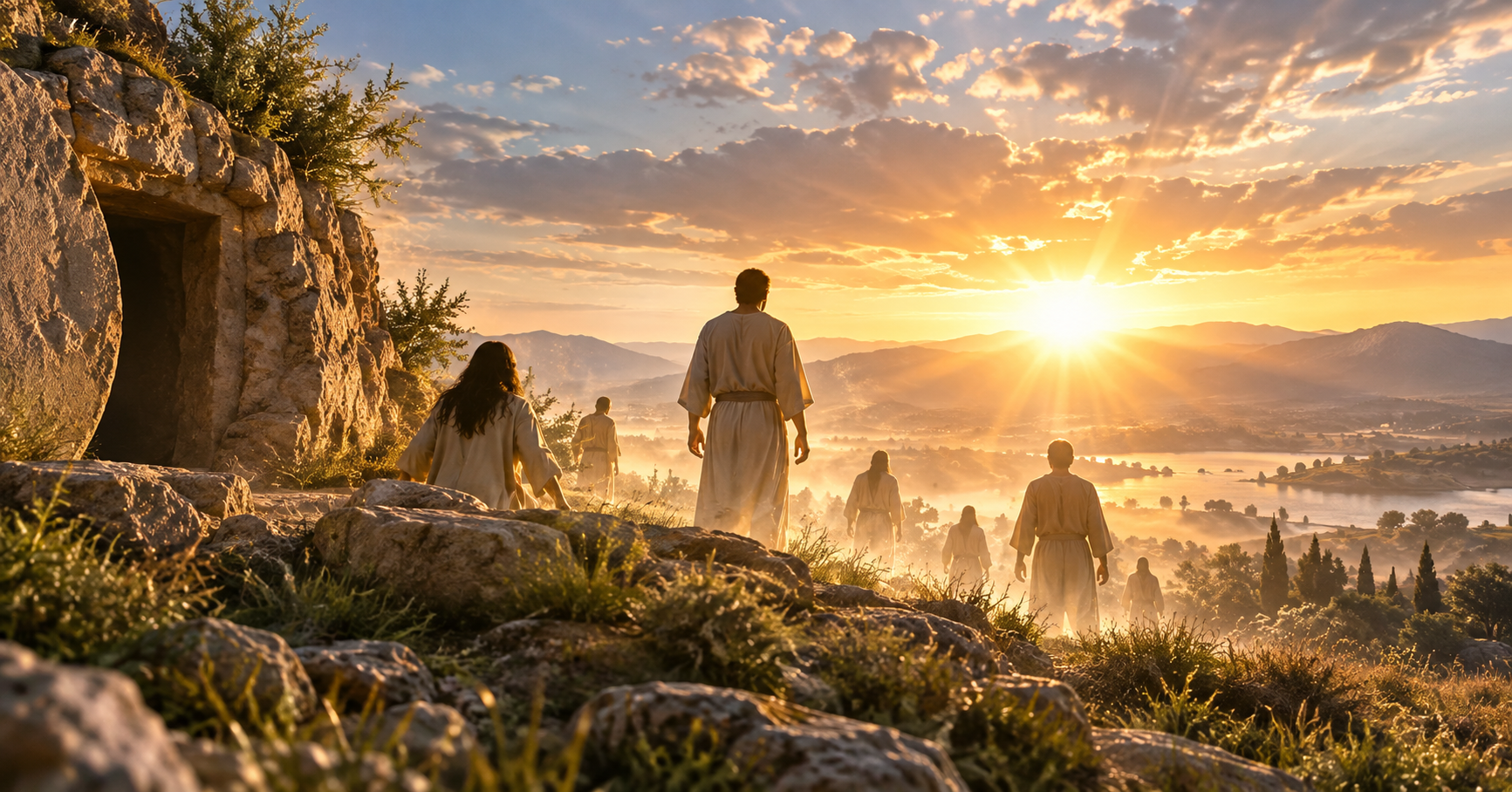
Featured Snippet: The Bible teaches that the dead are unconscious and await a future resurrection. At Jesus Christ’s return, faithful believers will be raised to immortal life in the first resurrection. Scripture also reveals a later resurrection when those who never truly knew God will be raised and given their opportunity to understand His truth, followed ultimately by a final resurrection to judgment.
Death raises one of the most important questions we can ever ask: What happens next?
Many Christians have been taught that at death an immortal soul immediately leaves the body and goes to heaven or hell. But when we examine the Bible carefully, we find a different—and remarkably hopeful—picture.
The Bible repeatedly describes death as a sleep from which only God can awaken us. The Christian hope is therefore not centered on an immortal soul escaping the body at death. It is centered on the resurrection of the dead.
Jesus Christ Himself declared:
“The hour is coming in which all who are in the graves will hear His voice and come forth” (John 5:28-29).
Notice where they are when Christ calls them: in the graves.
The resurrection is one of the great promises running throughout Scripture. And the Bible reveals that there is more than one resurrection.
What Does Resurrection Mean in the Bible?
To resurrect means to raise someone from the dead—to restore life where death had occurred.
The apostle Paul considered the resurrection so fundamental to Christianity that he wrote:
“If there is no resurrection of the dead, then Christ is not risen” (1 Corinthians 15:13).
He continued:
“And if Christ is not risen, your faith is futile” (verse 17).
Christianity stands upon the reality of resurrection.
Jesus Christ was raised from the dead, and His resurrection makes possible the future resurrection of those who belong to Him.
Paul explained:
“But now Christ is risen from the dead, and has become the firstfruits of those who have fallen asleep” (1 Corinthians 15:20).
Christ is the firstfruits—the first to be raised from death to eternal, glorified life. Others will follow.
Does the Bible Teach That the Dead Are Conscious?
The Bible frequently compares death to sleep.
Solomon wrote:
“For the living know that they will die; but the dead know nothing” (Ecclesiastes 9:5).
He added:
“There is no work or device or knowledge or wisdom in the grave where you are going” (verse 10).
David similarly wrote:
“For in death there is no remembrance of You; in the grave who will give You thanks?” (Psalm 6:5).
Jesus Himself used the imagery of sleep when speaking about Lazarus.
“Our friend Lazarus sleeps, but I go that I may wake him up” (John 11:11).
When His disciples misunderstood Him, Jesus stated plainly:
“Lazarus is dead” (verse 14).
Death is therefore pictured as an unconscious sleep awaiting an awakening, a subject examined more fully in what the Bible teaches about what happens after death.
This is why the resurrection is so important. If people were already experiencing their eternal reward immediately after death, resurrection would lose its biblical significance.
Instead, Scripture directs our hope toward a future moment when God raises the dead.
When Will Christians Be Resurrected?
The Bible connects the resurrection of faithful Christians directly with the return of Jesus Christ.
Paul wrote:
“For the Lord Himself will descend from heaven with a shout, with the voice of an archangel, and with the trumpet of God. And the dead in Christ will rise first” (1 Thessalonians 4:16).
Those Christians who are still alive at that time will then be changed and join the resurrected saints:
“Then we who are alive and remain shall be caught up together with them in the clouds to meet the Lord in the air” (verse 17).
Paul describes the same event in 1 Corinthians:
“For the trumpet will sound, and the dead will be raised incorruptible, and we shall be changed” (1 Corinthians 15:52).
The resurrection of faithful Christians therefore occurs when Christ returns, not at the moment each Christian dies.
This connects directly with what Scripture reveals about what happens at the return of Jesus Christ: Christ returns as King, the dead in Christ are raised, and His faithful servants begin reigning with Him.
What Is the First Resurrection?
Revelation gives this resurrection a specific name.
John wrote:
“And they lived and reigned with Christ for a thousand years” (Revelation 20:4).
Then he explains:
“This is the first resurrection” (verse 5).
And:
“Blessed and holy is he who has part in the first resurrection. Over such the second death has no power” (verse 6).
Those raised in the first resurrection receive immortality.
They will no longer be subject to death.
Paul describes the transformation:
“For this corruptible must put on incorruption, and this mortal must put on immortality” (1 Corinthians 15:53).
This is an important distinction. Human beings do not naturally possess immortality. Immortality is something God gives.
Those in the first resurrection receive the gift of Immortality when Christ returns.
Who Will Be in the First Resurrection?
The first resurrection includes those who belong to Christ and have faithfully followed Him.
Paul wrote:
“But each one in his own order: Christ the firstfruits, afterward those who are Christ’s at His coming” (1 Corinthians 15:23).
Revelation describes these resurrected Christians as serving with Christ:
“They shall be priests of God and of Christ, and shall reign with Him a thousand years” (Revelation 20:6).
This introduces the next major stage in biblical prophecy: the Millennium—the thousand-year reign of Jesus Christ on the earth.
The first resurrection therefore isn’t merely about receiving eternal life. God has a purpose for those He raises: they will serve as kings and priests under Jesus Christ in His Kingdom.
Are There Other Resurrections?
Yes.
Revelation 20 makes an important statement immediately after describing those who reign with Christ:
“But the rest of the dead did not live again until the thousand years were finished” (Revelation 20:5).
If there is a first resurrection, there must necessarily be another resurrection afterward.
Jesus also indicated that different resurrections would occur.
He said:
“The hour is coming in which all who are in the graves will hear His voice and come forth” (John 5:28-29).
The Bible therefore reveals an orderly plan in which God raises the dead according to His purpose and timing.
What Is the Resurrection Described in Ezekiel 37?
One of the clearest pictures of a future physical resurrection appears in Ezekiel’s vision of the valley of dry bones.
Ezekiel saw bones scattered throughout a valley. God asked him:
“Son of man, can these bones live?” (Ezekiel 37:3).
God then caused the bones to come together. Sinews, flesh and skin covered them, and finally breath entered them.
“Breath came into them, and they lived, and stood upon their feet, an exceedingly great army” (verse 10).
God explains exactly whom the vision represents:
“Son of man, these bones are the whole house of Israel” (verse 11).
These people knew they had previously died:
“Our bones are dry, our hope is lost, and we ourselves are cut off!”
God responds:
“Behold, O My people, I will open your graves and cause you to come up from your graves” (verse 12).
This is not merely symbolic language about national restoration. The imagery describes people coming from their graves and being restored to physical life.
This passage helps us understand that God’s plan extends far beyond those called during this present age.
What About People Who Never Truly Knew God?
Billions of human beings have lived and died without ever having a genuine opportunity to understand the God of the Bible.
Some lived centuries before Christ.
Others lived in cultures where the Bible was unavailable.
Still others may have heard the name of Jesus but never truly understood God’s calling, His truth or His plan of salvation.
Does God condemn such people without giving them a genuine opportunity to know Him?
Understanding this question also requires us to examine what the Bible teaches about the immortal soul and the condition of the dead.
Scripture reveals a much more hopeful plan.
Jesus made a remarkable statement when speaking to people who rejected Him:
“The men of Nineveh will rise up in the judgment with this generation” (Matthew 12:41).
He similarly said:
“The queen of the South will rise up in the judgment with this generation” (verse 42).
People separated by many centuries will rise together in a future judgment.
This fits the picture revealed in Revelation 20.
What Is the Great White Throne Judgment?
After the thousand-year reign of Christ, John sees another resurrection associated with judgment:
“Then I saw a great white throne and Him who sat on it” (Revelation 20:11).
Then:
“And I saw the dead, small and great, standing before God, and books were opened” (verse 12).
The Greek word translated “books” is biblia, from which we get the English word Bible.
The passage continues:
“And the dead were judged according to their works, by the things which were written in the books.”
This judgment should not automatically be understood as an instantaneous sentencing to condemnation.
Biblically, judgment can involve a period of evaluation during which people are accountable for how they respond to God’s revealed truth.
Those resurrected will finally be able to understand God’s way and respond to Him.
We will examine this remarkable period more fully in our upcoming article, What Is the Great White Throne Judgment?
Is There a Final Resurrection to Judgment?
Scripture also reveals that God’s plan includes a final judgment for those who knowingly and permanently reject Him.
Revelation describes the lake of fire:
“Then Death and Hades were cast into the lake of fire. This is the second death” (Revelation 20:14).
Notice the expression second death.
A second death requires that a person first be alive again.
Unlike the first resurrection, over which the second death has no power (Revelation 20:6), those who ultimately reject God, face destruction in the lake of fire.
Jesus warned:
“Fear Him who is able to destroy both soul and body in hell” (Matthew 10:28).
The final penalty for sin is death—not eternal conscious torment in hell.
As Paul wrote:
“For the wages of sin is death, but the gift of God is eternal life in Christ Jesus our Lord” (Romans 6:23).
The contrast is straightforward:
Death is the penalty. Eternal life is God’s gift.
The Resurrection Reveals the Fairness of God’s Plan
Understanding the resurrections helps answer one of Christianity’s most difficult questions:
What happens to all the people who never had a genuine opportunity to know God?
The biblical answer reveals both God’s justice and His mercy.
God is not desperately trying to save the entire world before everyone dies.
He has a plan.
Christ is the firstfruits.
Those who belong to Him will be raised at His return.
Christ and the resurrected Christians will reign during the Millennium.
Afterward, others who lived and died without fully understanding God’s truth will be raised and given their opportunity to know Him.
Finally, those who knowingly and permanently reject God will face final judgment.
Paul expressed God’s desire clearly:
God “desires all men to be saved and to come to the knowledge of the truth” (1 Timothy 2:4).
God’s plan of salvation is larger—and more hopeful—than many people realize.
The Christian Hope Is the Resurrection
When Christians grieve the death of someone they love, Scripture does not direct their hope toward an immortal soul that has already received its final reward.
Paul instead pointed Christians toward the resurrection at Christ’s return.
After describing the dead in Christ rising, he wrote:
“Therefore comfort one another with these words” (1 Thessalonians 4:18).
That is the biblical comfort.
Death does not have the final word.
The grave does not have the final word.
God does.
Jesus said:
“I am the resurrection and the life. He who believes in Me, though he may die, he shall live” (John 11:25).
The great Christian hope is that the dead will live again.
Jesus Christ will return.
The dead in Christ will rise.
God will complete His purpose for humanity.
And ultimately:
“There shall be no more death, nor sorrow, nor crying” (Revelation 21:4).
The doctrine of the resurrection therefore isn’t simply a teaching about what happens after death.
It is a revelation of the extraordinary hope at the center of God’s plan for mankind.
Continue Studying
- What Happens at the Return of Christ? — See how the resurrection of the saints fits into the events surrounding Jesus Christ’s return.
- What Is the Millennium? — Discover what the Bible reveals about the thousand-year reign of Jesus Christ and the resurrected saints.
- What Is the Great White Throne Judgment? — Examine the resurrection and judgment of those who lived without a full opportunity to understand God’s truth.
- What Happens After Death? — Examine what Scripture says about death, consciousness and the hope of resurrection.